


What is the DEFCON EMP Alert System?
The DEFCON™ is a low-cost device designed to detect electrical disturbances from an EMP or CME. This monitoring unit plugs into any standard 120-volt AC receptacle.
The unit provides immediate awareness during a solar storm or high-altitude detonation. Its sophisticated sensors track voltage fluctuations across the local electrical grid constantly.
This proactive detection allows homeowners to secure critical hardware. Constant vigilance is necessary as grid threats can arrive without visual or audible cues from the environment.
How does EMP ALERT™ detect E1, E2 and E3 of an EMP/CME?
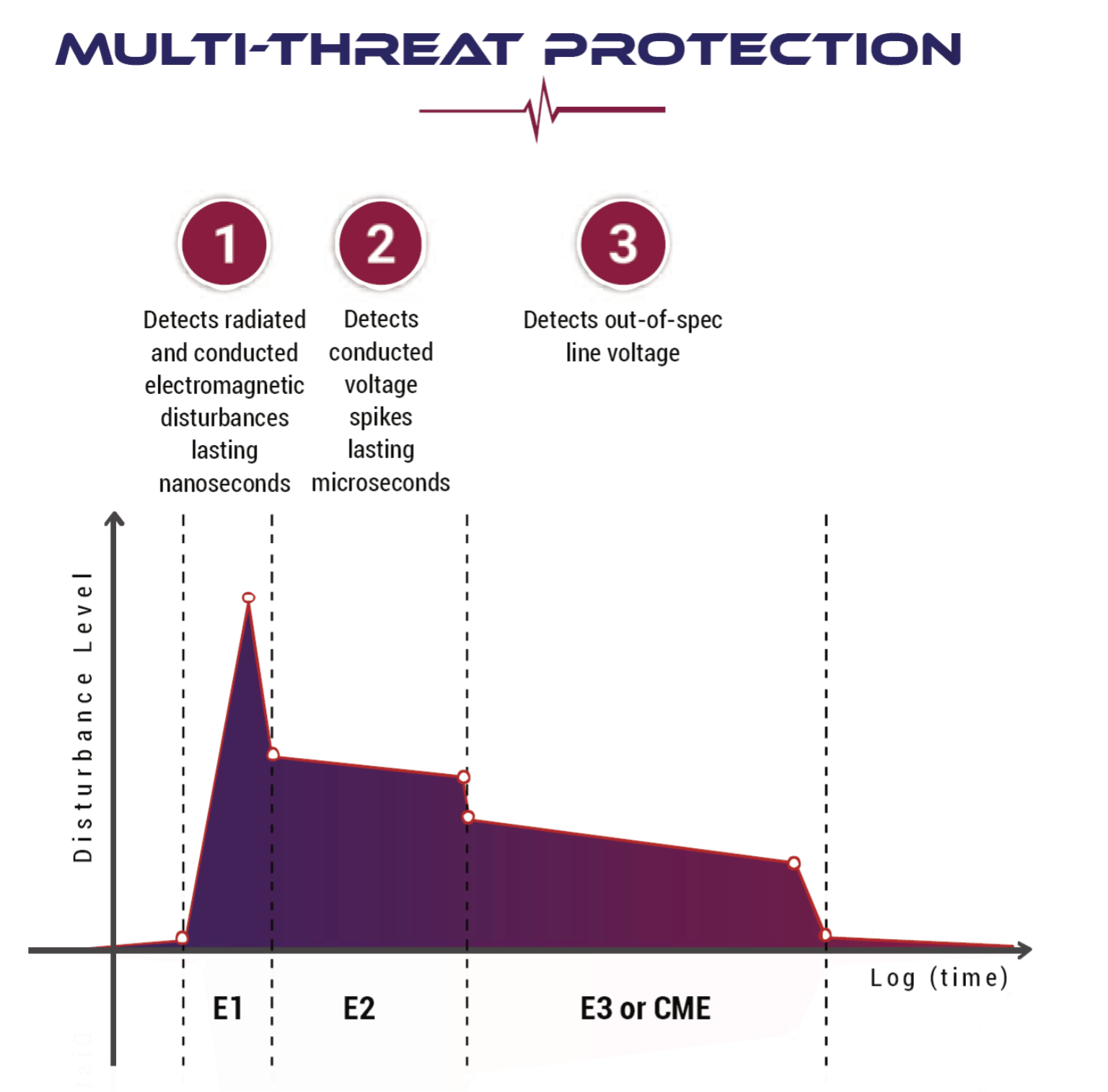
E1 and E2 are detected by high-speed circuits. E3 is detected by a circuit monitoring the power lines continuously.
These specialized circuits react within nanoseconds to identify the specific signatures of harmful electromagnetic interference. Each phase of an event is analyzed in real time.
By separating these different pulse types, the device ensures precision. This technology filters out standard power noise while remaining sensitive to genuine electromagnetic threats.
How does the DEFCON™ warn of an EMP/CME?
The DEFCON™ provides three distinct audible alarms:
- (1) a brief ‘beep’ for E1/E2-type pulses
- (2) a long sustained ‘beeeeep’ for E3 overvoltage
- (3) a pulsating ‘beep-beep-beep’ for E3 undervoltage.
Red lights also become visible when any detection occurs. These visual cues serve as a secondary confirmation if you are in a high-noise environment during the event.
The 85 dB alarm ensures that you can hear the notification from other rooms. This clear distinction between pulse types helps you understand the specific nature of the disturbance.
Won’t I already know if an EMP/CME occurs?
Most people will have no way of knowing. Detonations high in the atmosphere produce no visible flash or explosion sound. The DEFCON™ notification tool provides that missing notification house-wide.
Without a dedicated sensor, you might mistake a pulse for a simple power outage. Early warning is vital for securing sensitive electronics before permanent damage occurs.
Most grid failures appear identical at the start. Real-time data from a specialized sensor is the only way to confirm a pulse event while time remains to act. This proactive approach saves equipment.
What good is it knowing that an EMP or CME is occurring?
Knowing the danger gives you time to open your main breaker. The DEFCON EMP Alert System ensures you can warn your family immediately.
Fast action allows you to disconnect backup generators and solar arrays. You can also place small communication devices into Faraday shields during those critical first seconds.
This response window is essential for long-term survival. Protecting your infrastructure from the initial surges can preserve your ability to generate power and communicate later.
Won’t an EMP immediately take down the power grid?
Sustained E3 energy damages transformers over time. The DEFCON™ gives you time to take action while E3 begins.
While the E1 pulse is nearly instantaneous, the ground-induced currents of E3 can build up over several minutes. This window allows for emergency protocols to be executed.
The ability to differentiate between these phases means you are not acting blindly. Precise awareness ensures you follow the correct shutdown steps as the situation evolves.
If I have surge protection, do I need this device?
Surge protectors do not stop sustained E3 energy. This unit complements protection by warning you before voltages become fatal.
Traditional surge suppressors are designed for short spikes from lightning or grid switching. They cannot mitigate the long-duration saturation caused by severe solar weather events.
Integrating this system into your prep strategy provides a complete safety loop. It fills the gap left by standard residential surge equipment during massive events.
Unique Features of DEFCON™
- Warns of both EMP and CME disturbances
- Detects high-frequency E1/E2 impulses
- Detects out-of-spec line voltage from E3
- Sound 85 dB alarm with unique tones
- Hardened analog design with no digital electronics
- Plugs into standard 120-volt AC receptacle
- Designed and manufactured in the USA
- Constant monitoring with low power draw
- Durable construction for long-term placement